
Pitching to agents is a big draw at writers’ conferences. Thousands of aspiring writers pay an extra premium above the conference cost to pitch their unpublished manuscripts to agents and editors. The slots are limited, and they sell out fast. What are the odds for writers pitching to agents to get representation? The lack of information regarding their rate of success raises this question.
Lack of Information
Some agents have acknowledged the difficulty of telling writers face-to-face that they aren’t interested in their work; it’s easier to tell them to send their manuscripts. The writers think they have a leg up because of their pitches, but the truth is that their manuscripts end up in the slush pile with hundreds of others. The pitches they paid for don’t give them an edge.
What Happens During Pitching Sessions?
Pitching sessions are like speed dating on steroids. Authors seeking representation are given a set time, anywhere between 90 seconds and 15 minutes, to tell agents about their unpublished manuscripts. The sessions are held in rooms where nervous writers stand in lines anxiously waiting to pitch to the agents of their choice. The author Faye Hicks described the pitching session at a Pitch Slam as bedlam, packed and noisy.
Key Pitching Advice
Writers are told that the best pitches have no more than twenty-five words. Mentally rehearsing and polishing their pitches while they wait, they hope their pitches will hook the agents of their dreams. A writer who attended several pitching sessions without successful results stated on a writers’ forum that standing on a street corner during a blizzard with a cardboard sign asking for donations was preferable to participating in a pitching session.
The Reason Aspiring Writers Pitch
Why do aspiring writers subject themselves to an experience that so many of them describe as nerve-wracking? The answer is in sheer numbers. There are literally thousands of writers sending query letters to literary agents trying to get representation. These writers hope that pitching in person will improve their odds.
The Difference Between Baseball Odds and Writers’ Conference Pitching Odds
In baseball, it is easy to find out how well a pitcher is doing: we look at his stats for wins, walks, and strikeouts. Statistics are available for a game, a season, or consecutive years. There are no statistics for pitching at writers’ conferences. Instead, there is anecdotal evidence, the smiling faces of happy writers who found agents by pitching at conferences. But some of those writers found the agents years ago.
What Happens After the Initial Pitch?
To be fair, getting an agent is a longer and more complicated process than pitching at a baseball game. The author’s initial pitch must hook the agent into wanting to read the first two or three chapters. If the chapters are promising, the agent will request the full manuscript (some agents request a full initially).
Other Options
But what if the novel falls apart somewhere before the end? Then the agent will either pass or be willing to work with the author to fix the problem. It could also happen that an agent would pass on the initial manuscript but be sufficiently enthusiastic about the author’s writing to encourage a future submission that could eventually lead to representation.
Agents Speak Out
Andrew Zack was one of first literary agents to speak out regarding pitching at conferences. On a blog post in 2012, Zack stated flatly that “…verbal pitch sessions at writers’ conferences are useless…it’s the writing that counts.” Zack also related that he got into trouble for telling writers that he wasn’t interested in their work. The conference organizers were concerned that his honesty would lead to author dissatisfaction and buyer’s remorse.
An editorial director at Random House Children’s Books said in an interview that she gets as many as thirty pitches per conference she attends, and she has yet to acquire a manuscript as a result. In a blog post Rant: Pitch sessions are the spawn of Satan, Janet Reid, the late literary agent, said that pitching is evil because “…it sets writers up to fail.”
Realistic Odds
At the present time it is impossible to know what the odds are for writers pitching to agents at conferences. If a conference has three hundred fifty aspiring writers pitching and five percent of them are successful, seventeen would have found agents. But when conference web pages are using testimonials that are ten years old from authors who have successfully pitched, perhaps the odds are more like two percent, which I suspect is a more accurate figure. I also suspect that conference pitching sessions will be fully enrolled again this year, regardless of the odds.
Marian D. Schwartz
My aim in writing The Writers’ Conference was to create a fast, entertaining read that would shed light on the closeted world of publishing. Stories can tell us what we need to know. To find out more, click here: https://mariandschwartzbooks.com/the-writers-conference
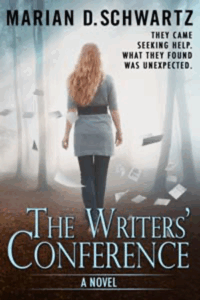
“In The Writers’ Conference, Marian D. Schwartz tackles the topic with glee, laying bare the underbelly of one such event…a fun read for everyone, and a useful education for anyone who might be thinking of a writing career.
Peter C. Foster, author